



Rivertown Leaders Join Forces To Condemn ICE Tactics And Call For Reform

 • Bookmarks: 333
 • Comments: 1
By Barrett Seaman–
Inside the first three weeks of February, five rivertown village boards have passed formal resolutions expressing concern over tactics utilized by Immigration and Customs Enforcement (ICE) and Customs and Border Patrol (CBP) agents, urging the Trump administration to adopt more rigorous training to prevent the kind of abuse Americans witnessed in Minneapolis.
At their February 3rd meeting, Ardsley trustees approved a statement decrying “the increasingly aggressive and provocative manner” in which ICE has pursued its goals. “As elected leaders,” their statement continued, “our foremost responsibility is to ensure that everyone who lives in, works in, or visits Ardsley feels safe and protected.” To that end, the statement read, the board is reviewing policies and procedures guiding police interaction with ICE agents.



That same evening, the Hastings-on-Hudson board unanimously adopted a resolution stating that “the continued deployment of ICE and CBP agents in our communities is threatening the lives, safety and civil rights of residents….” The resolution further called for the federal government to conduct “an independent investigation” of ICE and CBP tactics, adopt procedures to prevent abuse and consider reform of these enforcement agencies.
A week later, Dobbs Ferry adopted a resolution calling the federal agencies’ tactics as “heinous.” Mayor Christy Knell specifically cited events in Minnesota as catalysts for the village’s posture, which, like the other village positions, petitioned Washington to recall, reform and investigate the offending agencies.
Addressing the relationship between the village’s own police and immigration enforcers, the Dobbs resolution and a subsequent letter to residents stated that while the village would continue to cooperate with federal agents in cases involving serious crimes, “it has not been and will not be the role of our police officers to enforce federal immigration laws.”
This “neither help nor hinder” approach, widely practiced by municipalities not politically aligned with the Trump administration, was first formulated locally by Irvington lawyer and current Westchester County legislator David Imamura. That was nearly nine years ago when ICE agents began executing hardline deportation policies at the beginning of Trump’s first term. In March 2017, Irvington’s Board of Trustees unanimously passed a resolution stating that its law enforcement officials would “not engage in activities solely for the purpose of enforcing federal immigration laws” and not honor detention requests from immigration enforcement agencies without judicial warrant. The three-page resolution further committed that the village would not cooperate in the creation of any kind of registry or share personal information unless there is evidence of criminal activity.
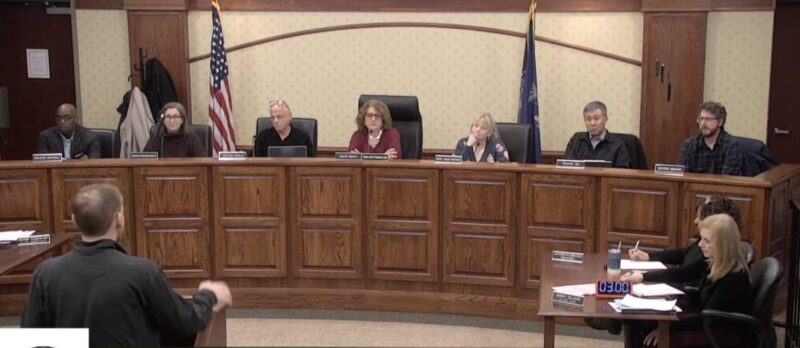
Irvington’s policy still stands. Now, Imamura is advising other rivertown governments; thus it is no surprise that the language of the various village resolutions is similar. The resolution voted on by Tarrytown trustees at their February 18 meeting—and one voted on that same night by Ossining’s board—is almost identical to that approved by their counterparts in Hastings two weeks earlier. Before opening the meeting to public comment, Mayor Karen Brown said the board had received “more letters about this resolution than about any issue I can remember.”
The sentiment expressed in those letters and emails was overwhelmingly supportive, commented the mayor, and that response was reiterated in the public comments section of the hearing. If there was an element of criticism it was that petitions to the federal government were a good start but weren’t enough. Public indignation, said resident Monique Kozlowski, “is completely well-founded…but the indignation has to be followed up with legislation.”
What such legislation would say and how effective it would be are harder questions to answer. The latest round of petitions and resolutions, much like what Imamura crafted nearly a decade ago, dance along a thin line between effective resistance and an invitation for the feds to crack down on its opponents. Tarrytown Police Chief John Barbalet explained that when he outlined just what the village law enforcement policy has been regarding ICE:
“We have policies on how to interact with ICE if they come here,” he said. “We don’t.” In the three times ICE has come to town, he recounted, “we found it’s a little more beneficial to the community if we have a cordial relationship with them, because they are the federal government and they have no problem telling us that they can come in and do what they want.” So Tarrytown officers are instructed to seek out the federal agent in charge, ask politely that if they do detain someone from the village, “they tell us the person’s name and where they are going.” For those three incidents, he said, “that seemed to work.”

To some that sounds like appeasement, but the message of Minneapolis is that the alternative, resistance, can backfire badly. What’s left, suggests Chief Barbalet and others with experience in such matters, is to educate people on their rights and on what precautions to take, what to do if a family member or loved one is detained. “There is a certain level of agility and nimbleness that we as a community must exhibit at all times,” advised Alberta Jarane, an African American who owns two Tarrytown restaurants that employ vulnerable immigrants. “This is an issue that I as a businessperson in Tarrytown think about daily, hourly.”
The other defense is to join forces with others. “If ever there was a time for the two communities, Tarrytown and Sleepy Hollow, to work together,” urged Jarane, “this would be a good time.”
Notably absent from the list of villages that have passed resolutions is Sleepy Hollow, ironically home to one of the area’s largest and most vulnerable populations of potential ICE targets. Mayor Marjorie Hsu acknowledges that her board has not formally discussed crafting such a document but counters that since Trump was elected in November 2024, the village has worked diligently to formulate policies designed to thwart the sort of chaotic invasion witnessed in Minneapolis and elsewhere.
“After the first ICE incident,” said Mayor Hsu, “I worked with Carola (Otero Bracco, Executive Director of the refugee support group Neighbors Link) to develop an ICE response template which Sleepy Hollow was the first to walk through in a tabletop exercise.” The group, which includes nonprofit, religious leaders and school representatives, continues to meet regularly. “Know Your Rights” postcards have been widely circulated. Sleepy Hollow and Tarrytown police regularly share information, and there are several local rapid response groups, she says, that are “ready to mobilize.”
The coordinated passage of resolutions by neighboring villages displays an impressive degree of community solidarity, but questions remain as to their effectiveness. “What do you think (these resolutions) will accomplish in our neighboring villages?” asks Hsu. “Will it make immigrants safer?”
Read or leave a comment on this story...




 Share
Share Print
Print


One thought on “Rivertown Leaders Join Forces To Condemn ICE Tactics And Call For Reform”