




Latest Challenge To Feiner’s Greenburgh Reign May Be His Toughest Yet

 • Bookmarks: 437
 • Comments: 2
By Barrett Seaman–
“It’s time.”
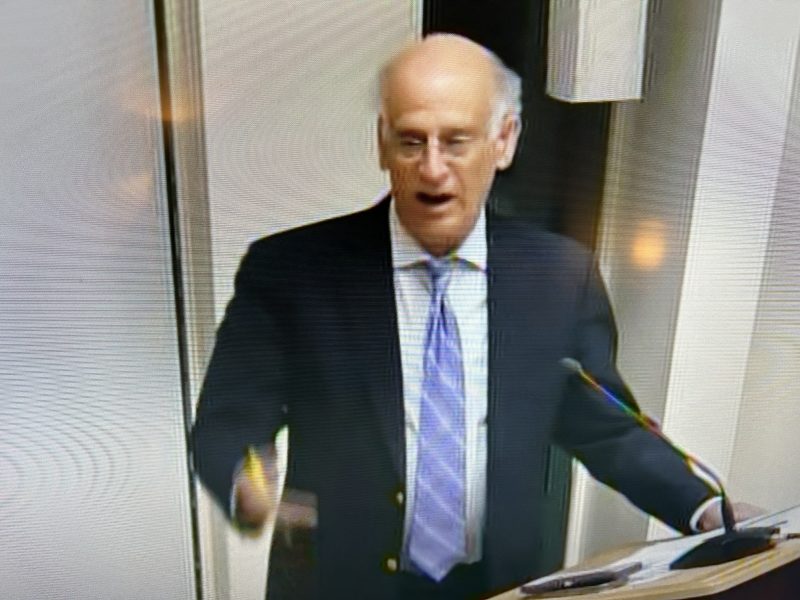
That terse comment, often repeated of late by Greenburgh Democrats, is being used to justify an intra-party challenge to Paul Feiner’s 34 years as Town Supervisor. Earlier this month, Greenburgh’s Democratic Committee endorsed Ardsley Village Trustee Barry McGoey as their preferred candidate with 83% of the vote over Feiner, the incumbent.



As in the past, this rejection by his own party has not dissuaded Feiner from running in the June 23rd primary. “Every time there has been a contested election,” the sitting Supervisor notes, “they (party district leaders) vote against me.”
Well, not quite, as Greenburgh Democrats chose not to endorse either Feiner or his challenger, Tasha Young, in 2021. But whether endorsed by his party or not, Feiner, who turned 70 this past week, has held his own through four contested general elections and two primaries. The challenger that came closest was Bill Greenawalt , who lost by 173 votes in 2005. Lucas Cioffi, running as an independent in 2019 lost by a two-to-one margin.
This time may prove different. A month before the district leaders voted to endorse McGoey, the auditing firm EFPR Group issued a “forensic review report” that cited multiple issues of financial mismanagement tied to Feiner’s leadership. The most egregious example is an accumulation of $29,390,813 in uncollected taxes dating back to 1967. The Water Department, according to the report, was also short some $3 million in unpaid bills, with almost half of them overdue for more than 60 days. Another $3 million reflected unpaid parking tickets, including a majority that have been delinquent for over three years.
Feiner plans to defend himself against these accusations by noting that the auditors stopped counting data at the end of 2023—after the COVID pandemic in which many homeowners found themselves under financial stress but before they recovered. Feiner plans to argue that, since then, collections have increased and that the gap is closing. Besides which, he points out, the town continues to maintain a Double-A bond rating.
He also implies that both the timing and the limited timeline of the report was politically motived; others, however, insist that the report was triggered after a new Comptroller, Kimberly Gutwein, was appointed in 2024 and began to review the books. As for the full litany of accusations, both in the forensic report and elsewhere, Feiner contends, “the Town Supervisor doesn’t have that much power. I’m only one of five town council members, and they are often against me.”
Others familiar with how the Greenburgh Town Board functions attest to a pervasive distrust between at least three of the four other elected council members on the one hand and the Supervisor. In addition to the funding anomalies cited in the EFPR report, several sources mentioned a $39 million budgetary line item set aside for construction of a new courthouse, which they say Feiner, as the town’s de facto chief financial officer, borrows from to balance other accounts when needed.
On top of these internal financial matters, Greenburgh suffered a major water main break in January that left as many as a thousand households without water for more than a week. Responsibility for that too ultimately landed on the Supervisor’s shoulders. The door was open for new blood, so when McGoey stepped up to challenge, he was quickly embraced.

“With Greenburgh’s financial mismanagement, increasing taxes, and crumbling infrastructure,” wrote Democratic Committee Chair Steve Bass in announcing McGoey’s selection, “the people are in need of new leadership. Barry has the experience necessary to deliver the change the public needs.”
Though only in his second term as an elected village trustee, McGoey brings with him more than 30 years of government-related service. He holds degrees in Accounting and Finance from Iona College, a Juris Doctor from Pace University School of Law and a Certificate in Strategic Human Resources Leadership from Cornell University. He has served as a New York State Court Officer and a City of Yonkers firefighter. For more than a decade he was President of the Yonkers Firefighters Union and as Legislative Director of the New York State Public Employees Conference. Perhaps most pertinent to the town’s financial challenges, he worked as an internal auditor.
On paper, Feiner’s re-election prospects may appear shaky, but he has not only survived 17 contests since first elected in 1991, he has more often than not won by landslide margins. Most would attribute his elective success to his relentless devotion to “constituent services.” He frequently rides his bike through the town, visiting with voters and responding to their complaints. For years, he has planted himself outside local supermarkets on weekends to hear citizen complaints; his phone number is prominently displayed on his car and he is known to answer those calls he can and return those he can’t. Whether these retail assets can once again buy him another election, however, appears to be in question.
Read or leave a comment on this story...



 Share
Share Print
Print

2 thoughts on “Latest Challenge To Feiner’s Greenburgh Reign May Be His Toughest Yet”