


FURRIES ARE FOLLOWING ME: Be Beast
By Krista Madsen
Furries are following me around the world.



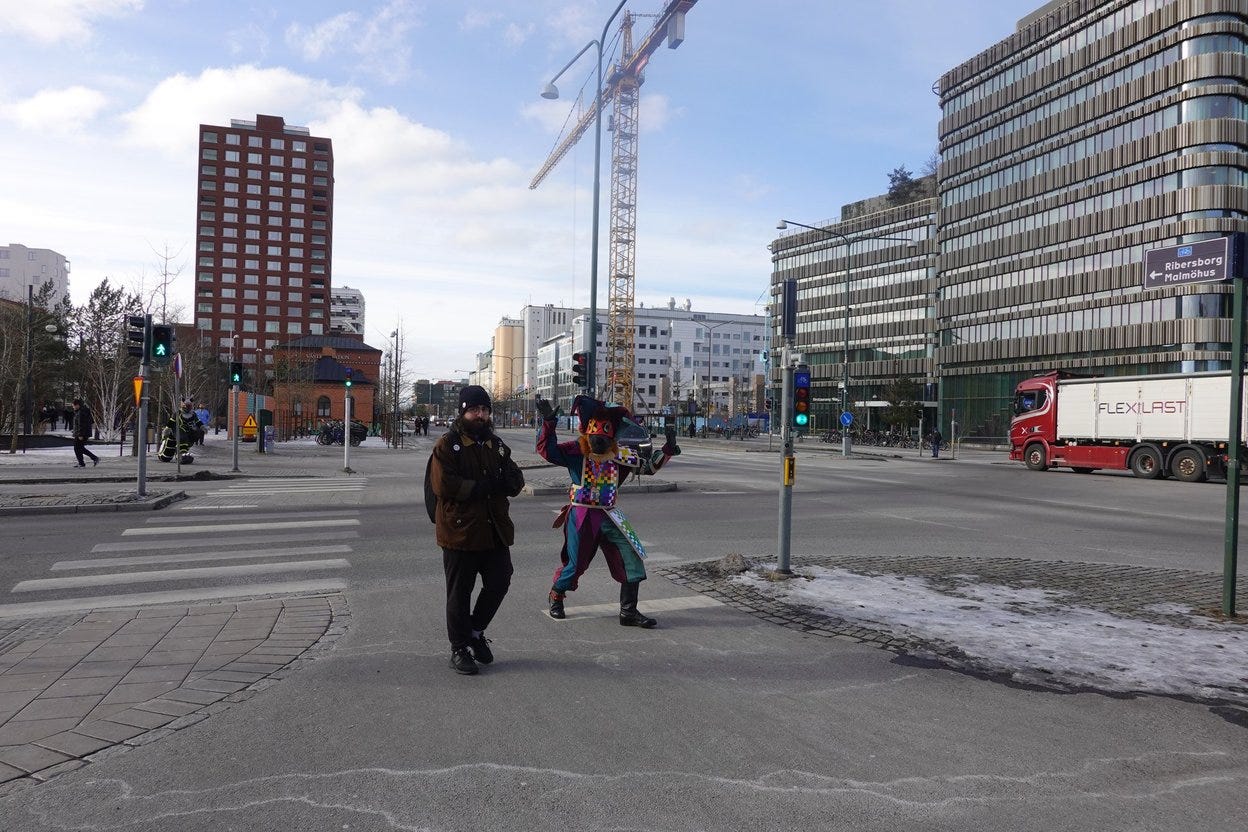
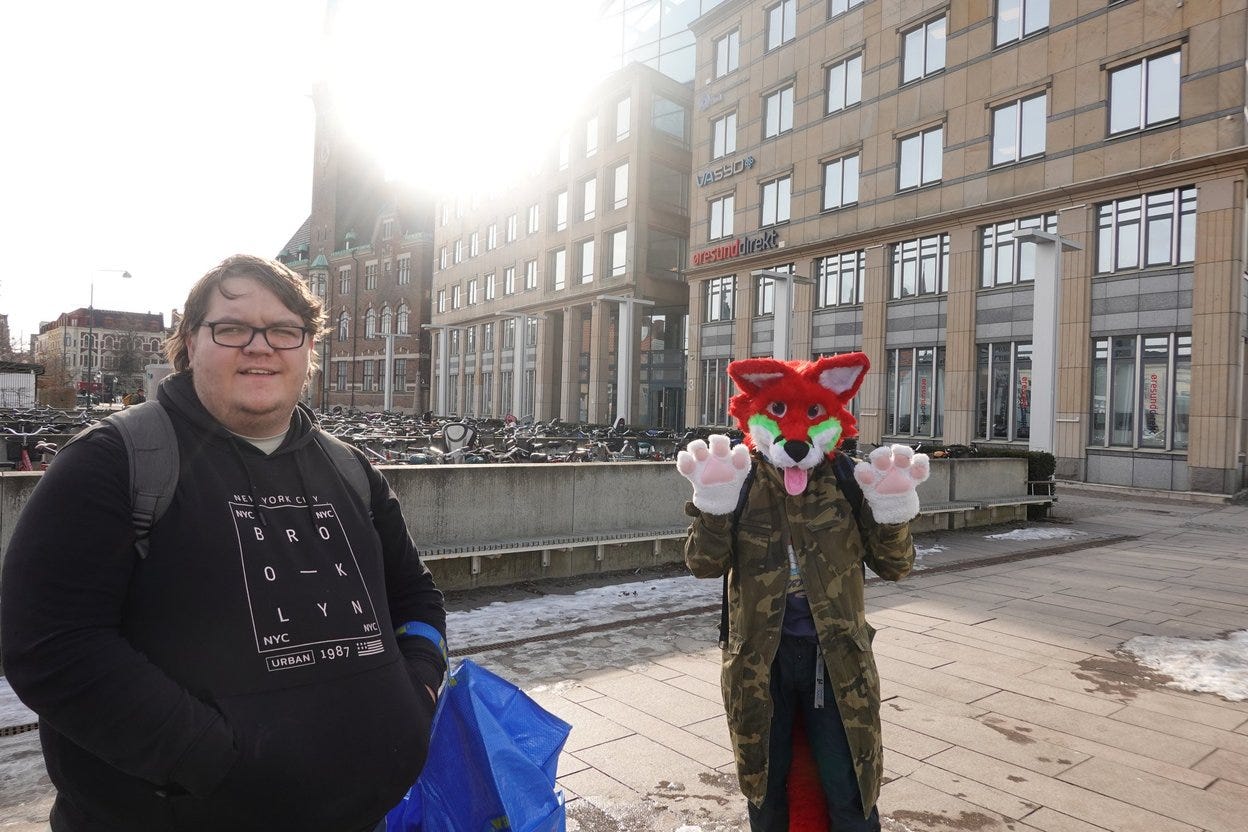
On my recent family trek around Nordica, my girl-teens and I came upon a gaggle of them—what would you call a group of Furries when they hail from all sorts of species?—in Sweden. At first someone with an animal head, fox I believe, came past us in a sweet little cobblestone alley surrounded by Shakespearian Tudor, in our chilly wanderings of Malmö. Then there were others—wolf, bear, oh my—gathering near the main train station. One of them, bare headed for now, had a Brooklyn sweatshirt and seemed like a normal human man who of course my kids were embarrassed I started to talk to. He told me they were here for the convention of course; his friend under the mask from Ireland I believe, and he from Boston. From there we’d depart over the 10-mile bridge back to Copenhagen, and here in a different country, these friendly furries seemed to follow. A whole parade of them was approaching us as we wandered the river’s edge trying to chip our way through the icy air to reach the little iconic Mermaid. Sadly, the video I captured of them all, eagerly waving with their big paws as they marched past, didn’t make it home. Perhaps deleted by my dread teen censors, I’ll never know. Encounter dozens of chubby walking teddy bears and it’s me the mother they find embarrassing, go figure.
The furries are even after my cohorts. A friend attending his astronomer conference in the western desert reported back that they were there too, sharing his hotel elevator in Phoenix. Did he saddle up to any at the bar and get some hairy tea? Unfortunately he had nothing more to report.
Furries, because they gravitate to where the wild things are, are even sometimes spotted at Mar-a-Lago.
“Why is this Party at Trump’s Mar-a-Lago Giving Furry Vibes?” asked Mathew Rodriguez on Jan 15, 2026, on Them.us. The answer: because it is.
Let them eat kibble.
A fundraiser held at Donald Trump’s Mar-a-Lago resort that featured people in dog masks and aristocratic attire has been criticized for both its allusions to gilded decadence and its furry-like atmosphere.
The Hero Dog Awards Gala, a fundraiser for dogs that work with law enforcement, included cocktails, dinner, and professional dancers; it was these paid dancers who wore the dog masks and swanky clothes.
Footage from the event, which took place on Friday, went viral on social media throughout the week. The clips featured dancers wearing masks representing various dog breeds engaged in 18th century-style dancing, clad in gowns and tailcoats.
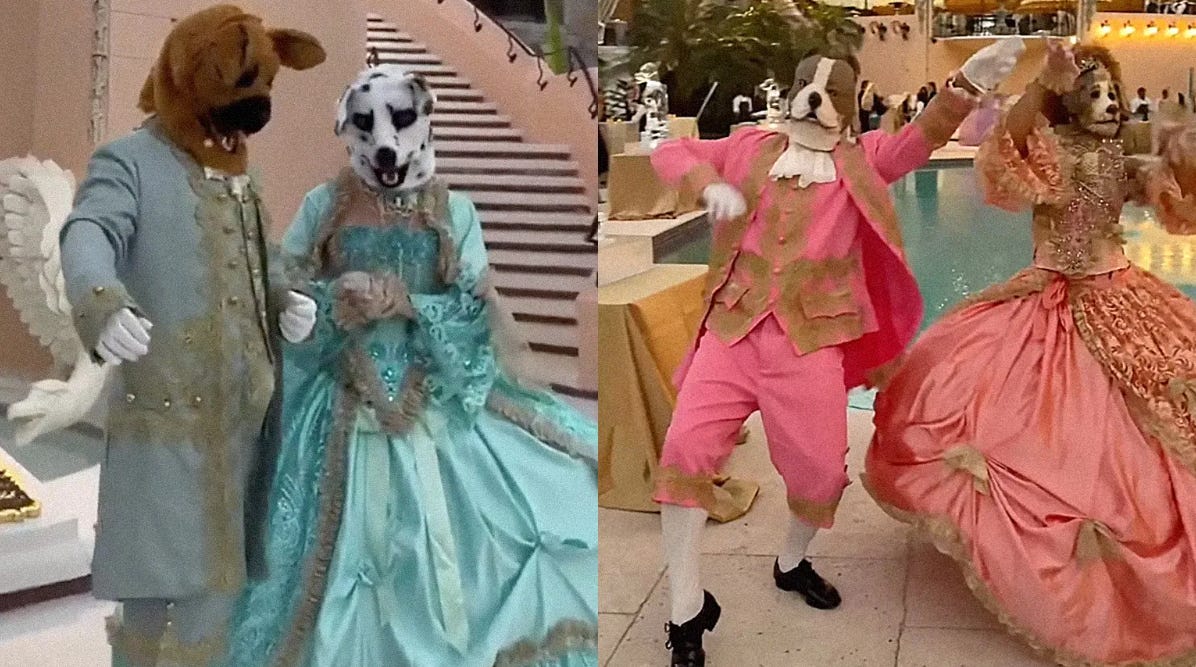
Not only do faux-fancy upright canines in suits remind me of the characters in my friend’s excellent cult classic fiction Monster Dogs, but they also speak to these odd (shall we say again say hypocritical) cosplaying tendencies of the right wing in this oddest of moments. Why do we always find so much unbelievable weirdness in the closets of the most vehement so-called Christians? Why is the faux-mourning Erika Kirk wearing glitter pantsuits surrounded by fireworks? So many contradictions when you can’t decipher smile from lies in a MAGA-surgery face. For all of Kristi Noem’s costuming, we now have the counter-costume of her husband with his balloon-laden tee-shirts. Everyone so painfully masked.
Yet despite hiring them for their entertainment, furries in particular have long been yet another thing that causes unfounded fury in the right wing.
Furries have often been used as an anti-trans scapegoat among right wing circles. In Texas, Republicans even introduced legislation to ban people identifying as animals in schools, despite that not actually happening.
Though some mistakenly seemed to think actual furries were at play during this event, others raised criticism about the tone deaf nature of the Aristocratic stylings as some experts say we are currently living in a new Gilded Age.
“This is some weird ass dystopian shit,” liberal commentator Vince Wilson said on X.
Curious to experience some weird ass dystopian shit for yourself? Or just get a soft hug from a somewhat familiar friend you may recognize from some demented Disney dream gone wrong? You can find a FurryCon near you here in this worldwide convention tracker. Looks like the one my family bumped into, NordicFuzzCon in Feb 2026, happened to overlap with our time in Sweden and leak into nearby Copenhagen just for fun.
NordicFuzzCon made its debut in 2013, with over 170 attendees from more than 10 different countries. In 2026, the convention welcomed 5,957 attendees from more than 66 countries, making NordicFuzzCon one of the largest international furry conventions in Europe.
These human-animal hybrid gatherings are getting ever more popular. Is it because the internet makes everything more popular, that the world is more accepting, that people require in these dire times more fur and costuming? Yes x3!
What happens at a furry convention? From the latest (freezing) FuzzCon,
NordicFuzzCon is an annual event taking place in Sweden. It is aimed at members of the international furry community—people with an interest in animals with human characteristics, such as Bugs Bunny or Donald Duck—but all are welcome to attend.
At the convention, we offer many different activities, including dances with live DJ sets, panels on art and costume-wearing, organised tabletop and video gaming, and much more! While we can’t guarantee you a good time, we do our utmost to offer the most scrumptious smörgåsbord of entertainment this side of the fjord.
It wouldn’t be Sweden without some smörgåsbord. More of this anime buffet from their About Furries page:
Furries are fans of anthropomorphic animals. An anthropomorphic animal is an animal with human-like characteristics. This includes many classic cartoon and comic book characters, such as Donald Duck, the Moomin, and Sweden’s very own Bamse. Anthropomorphic animals are a part of our everyday lives, and they have been a part of human culture for thousands of years from the Egyptian god Anubis to werewolves in folklore.
Most furries have a personal species. This is a species they identify with, and which they will use as an avatar online and in the real world. Some choose more fantastical creatures as their personal avatars, including dragons and unicorns, or even impossible cross-breeds such as folfs (fox combined with wolf). These become personal characters, often with some added distinguishing characteristics like clothing accessories or colourful fur patterns, and they are usually referred to as their fursona.
It is common for furries to get artwork made of their fursonas, and some even get complete costumes made based on these anthropomorphic avatars. These animal costumes are commonly referred to as fursuits.
Over the last decades, furry has become its own thriving international fandom. Every year, there are dozens of furry conventions all over the world. At these conventions, furries meet to create and sell art, dress up and cosplay as their fursonas, dance, and generally have a good time. Often, conventions will collect and donate money to animal-related charities as well.
A Bamse! A folf! I think we met those! Fursuits, fursonas. I just love hobbies that come with their own dictionaries.
For more answers to my many questions, I knew I’d find a niche for this in my beloved Reddit. Someone is always articulating what I want to, such as: “What’s up with furry conventions?” Is this sexual, innocent, everything in between? Yes, whatever you want.
People join the furry fandom for different reasons. It has a very high group of Neurodivergent people, so a lot of people gravitate toward it because of people like them. Some people (like myself) just like furries as a design, would never suit. Some people like being able to put on a mask (well, head, literally), to be someone they can’t be out of suit.
It’s been popular for decades, but it’s gotten more mainstream attention since the internet became mainstream.
Fursuits are usually toony because they would be in uncanny valley and less cute if realistic. There are also only a handful of top quality suit makers, and they each have their own styles. A suit costs several thousand dollars, it can be $500+ for just a partial (a head, feet, hands, and a tail), depending on the complexity of the character. It’s very specialized with little competition. I guarantee you if you go to a con, most people with suits will have gotten them from the same maker(s) because if you spend that kind of money, you want to make sure you’re getting good quality, and they’re usually like super high quality like your usual professional sports mascot costumes.
He who makes a beast of himself gets rid of the pain of being a man.
_Samuel Johnson from Anecdotes of the Revd. Percival Stockdale (1809)
What’s a profile of your typical furry, if there’s such a thing here as typical? Writes Hal Herzog, Ph.D., in Psychology Today:
Demographically, the furry fandom is comprised predominantly of white males in their teens to mid-twenties. For the most part, they represent what you would expect to find in a typical geek or nerd subculture: Above-average school performance (nearly half are college students), an interest in computers and science, and a passion for video games, science fiction, fantasy, and anime. Less typical, however, is the fandom’s LGBTQ demographics: Furries are seven times more likely than the general population to identify as transgender and about five times more likely to identify as non-heterosexual. Given this composition, it should come as no surprise that the furry fandom is a community defined in no small part by its inclusivity. This fandom embraces the norms of being welcoming and non-judgmental to all.
This author says furries are rarely, if ever, sexualizing these costumed activities. He doesn’t mention neurodiversity though the profile he outlines above seem to fit it. FurScience posits autism and furries definitely have a connection:
Many people on the autism spectrum thus become overwhelmed in highly stimulating, chaotic environments, and may seek quiet, order, or routine as a refuge. People diagnosed with autism also tend to have a range of differences in the ways their brains process information: for example, some have difficulty recognizing faces; some process verbal or auditory information more slowly; some are extremely sensitive to visual patterns. People on the autism spectrum often have difficulty displaying and interpreting nonverbal social cues, such as body language, tone of voice, and facial expressions, and may have trouble with non-literal social communications such as sarcasm. As a result, many have a harder time forming and maintaining social relationships, and may struggle to navigate school, get and keep a job, and find their place in a wider social community. Social isolation poses a significant threat to their quality of life.
While people on the autism spectrum often struggle to find a place where they belong, some find community, connection and friendship in creative cultures that are organized around shared interests. The furry fandom is one example. According to survey data from our research team, 10–15% of furries self-identify as being on the autism spectrum—a number that includes those who are formally diagnosed with autism, those who feel that they are on the spectrum despite not having been formally diagnosed, and those who are unsure whether they agree with the autism diagnosis they have received. For many of them, the furry fandom provides an important source of social connection, support, and fun.
I posited the theory in recent weeks that lighter eyes can be harder for the neurodivergent to make contact with when they somehow make the observer feel more exposed. Any eye contact no matter the eye color can be harder. It makes sense that a mask—and a friendly furry animal one at that—is best.
When I look back at the family history and my kids photos through the years, you’d think they were furries. The way the two piled in together to wear one oversized giraffe costume as their pandemic PPE for a few years around the house; how we took a friend along for their trio of full-animal gear to a birthday visit to a petting farm (kangaroo, elephant, giraffe). But we had to add an edge of menace to them. Our furries, not entirely comfy, came with Halloween-appropriate teeth. And my daughter’s exposed elephant eyes are clearly up to no good.
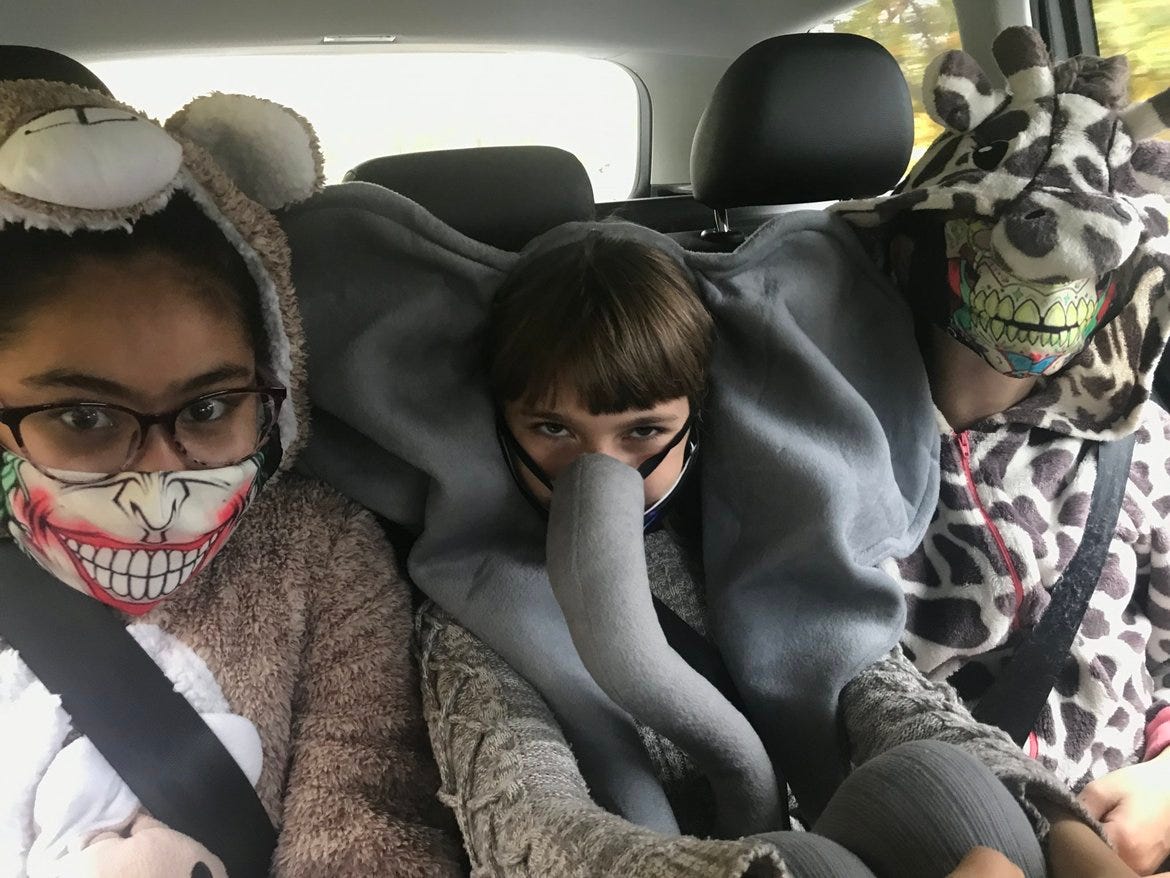
What’s the species of your inner animal? Does it want to come out? May we all be a little furrier.
I could get into this. I wonder what sort of cross-breed might suit best for the office?
 Krista Madsen is the author behind wordsmithery shop, Sleepy Hollow, inK., host of the occasional Sleepy Hollow Show & Tell series (next up May 28!) , and producer of the Edge|wise newsletter, which she is sharing regularly with The Hudson Independent readership. You can subscribe for free to see all her posts and receive them directly in your inbox.





 Share
Share Print
Print
